English

The process of carbon fiber wound tubes.
- Dec-05-2025
- (128) Views
This method utilizes wet winding, where resin-impregnated carbon fiber tows are directly wound onto a mandrel or liner under controlled tension using a winding machine, followed by curing.
The process mainly includes the following steps:
1. Raw Material Preparation: This includes carbon fiber bundles, resin solution, mandrel, and liner.
2. Liner Forming: First, clean the mandrel surface. Wrap a polyester film release agent around the straight pipe surface, and apply paraffin wax and polyvinyl alcohol release agent to the non-straight pipe parts. Then, place the liner material (such as polyethylene or polypropylene) into the mandrel and heat it to adhere to the mandrel surface.
3. Winding Reinforcement: Immerse the carbon fiber bundles in the resin solution through an impregnation tank, controlling the resin content with a scraper. Then, under the control of a tension controller, directly wind the resin-impregnated carbon fiber bundles onto the mandrel or liner surface Different winding angles and layers are selected according to different application requirements to achieve optimal performance. Generally, commonly used winding angles are 0°, ±45°, and 90°, where 0° provides longitudinal stiffness, ±45° provides torsional strength, and 90° provides hoop strength.
4. Demolding: Place the wound carbon fiber tube in an oven and allow it to cure. Different resins require different curing temperatures and times. Please refer to the resin's instructions for setting the temperature and time. Generally, the curing temperature is around 100°C to 150°C, and the curing time is around 1 to 2 hours. After curing, remove the carbon fiber tube from the mandrel. If surface finishing is required, processes such as sanding and painting can be performed.
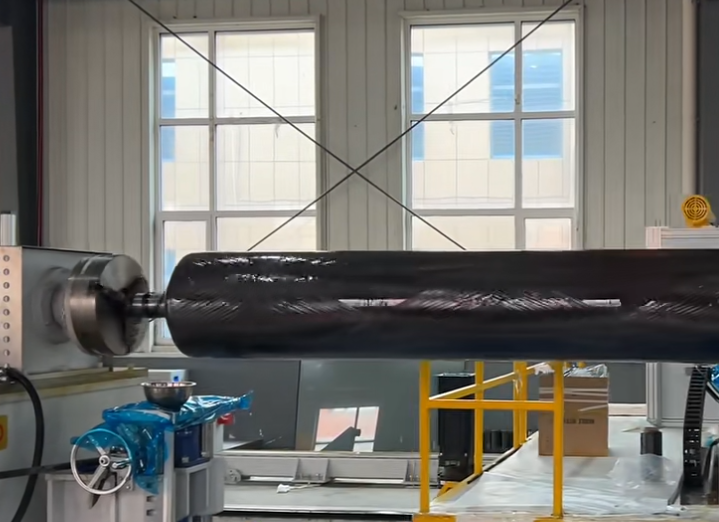
Advantages and disadvantages of carbon fiber wound tubes and coiled tubesThe advantages of spiral wound tubing include the ability to create complex curved shapes, making it suitable for manufacturing irregularly shaped tubing such as cones, spheres, and ellipses.The disadvantages of spiral wound tubing are that the layup angle is limited by the rotational speed of the mandrel and the movement speed of the carbon fiber ribbon, making precise control difficult. Furthermore, factors such as winding tension, winding speed, and resin viscosity can affect the stability of the resin content.The advantages of coiled tubing are the ability to control the layup sequence and angle, achieving strength distribution in different directions. It also offers better resin content stability and effectively solves problems such as inconsistent integral strength of line segments caused by uneven temperature during curing.The disadvantages of coiled tubing are that it is less design-dependent than spiral wound tubing, strength calculation is more complex, and it is difficult to create complex curved shapes.