English

Pultrusion and Resin Transfer Moulding,RTM
- Dec-19-2025
- (96) Views
Pultrusion
Process Concept
Fibers are pulled from a creel through a resin bath and then through a heated die. The die completes the impregnation of the fibers, controls the resin content, and cures the material into its final shape as it passes through the die. The cured profile is then automatically cut to a specific length. Fabric can also be introduced into the die to provide fiber orientations other than 0°. Although pultrusion is a continuous process that produces profiles with a constant cross-section, some variations can be introduced into the cross-section. This process involves pulling the material through the die for impregnation and then clamping it in the die for curing. This makes the process discontinuous but allows for minor variations in the cross-section.

Main Materials
The resin matrix is generally epoxy resin, polyester, vinyl ester, and phenolic resin, while there are no restrictions on the fiber type.
Main Advantages
i) This is a very fast and economical method for material impregnation and curing.
ii) Resin content can be precisely controlled.
iii) Fiber costs are minimized because most of the fibers come from spools.
iv) The structural performance of the laminate is excellent because the fibers in the profile are straight, and a high fiber volume fraction can be achieved.
v) The resin impregnation area can be enclosed, thus limiting volatile emissions.
Main Disadvantages
i) Limited to components with constant or nearly constant cross-sections.
ii) The cost of heated molds can be high.
Typical Applications
Used for beams and girders in roof structures, bridges, ladders, and frames.
Resin Transfer Moulding,RTM
Process Concept
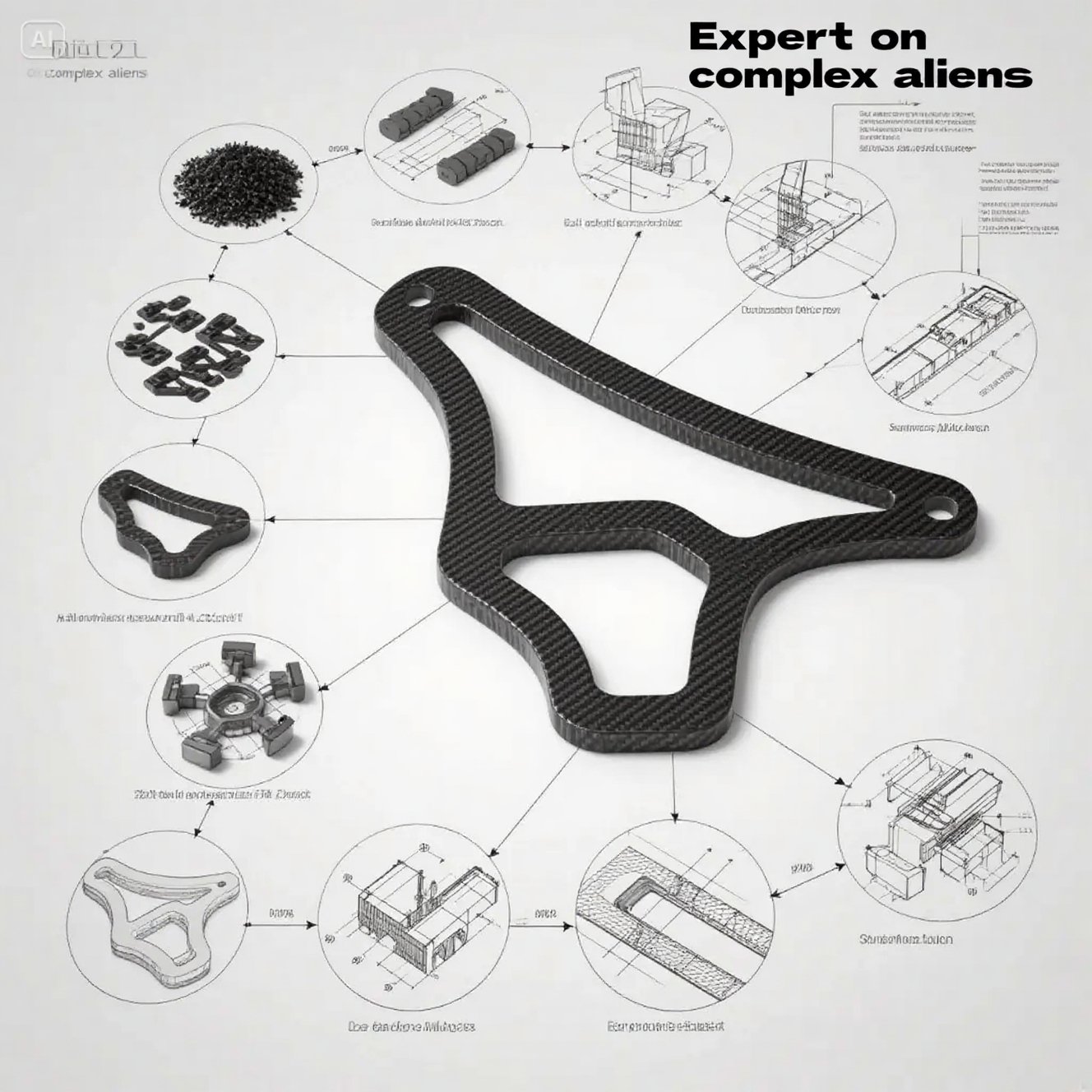
The fabric is stacked as a dry material, sometimes pre-pressed into a mold shape and bonded together with an adhesive, allowing these "preforms" to be more easily placed into the mold. A second mold is then clamped onto the first mold, and resin is injected into the cavity. Vacuum can also be applied to the mold cavity to help draw the resin into the fabric. This is known as Vacuum Assisted Resin Injection (VARI). Once all the fabric is wetted, the resin inlet is closed, and the laminate can be cured. Both injection and curing can be performed at ambient temperature or at elevated temperatures.

Main Materials
Resins typically include epoxy resins, polyester resins, vinyl ester resins, and phenolic resins, but high-temperature resins such as bismaleimide can also be used at higher processing temperatures. Fiber types are not limited; stitched materials work well in this process because the gaps allow for rapid resin transport. Some specially developed fabrics can aid resin flow. Main Advantages
i) High fiber volume laminates can be obtained with very low void content.
ii) Good health and safety and environmental control due to the enclosed resin system.
iii) Potential for reduced labor costs.
iv) Both sides of the component have a molded surface.
6.4 Main Disadvantages
i) The tooling is expensive and heavy to withstand the pressure.
ii) Generally limited to smaller components.
iii) Unimpregnated areas may occur, leading to very expensive scrap parts.
Typical Applications
Small, complex aircraft and automotive components, train seats.