English

What is unidirectional carbon fiber fabric?
- Dec-25-2025
- (114) Views
Unidirectional carbon fiber fabric is a non-woven form of carbon fiber reinforcement material characterized by all fibers extending in a single parallel direction. With this style of fabric, there are no gaps between the fibers, and the fibers lie flat. There is no cross-sectional weaving to split the fiber strength in another direction. This allows for a concentrated density of fibers that provides maximum longitudinal tensile potential, greater than any other fabric. It has three times the longitudinal tensile strength of structural steel and one-fifth of its weight density.

Similarly, composite parts made from carbon fiber provide ultimate strength in the direction of the fiber particles. Therefore, composite parts using unidirectional carbon fiber fabric as their sole reinforcement material offer maximum strength in only two directions (along the fiber direction) and are very rigid. This directional strength characteristic makes it an anisotropic material, similar to wood.During the part layup process, unidirectional fabrics can be overlapped at different angles to achieve strength in multiple directions without sacrificing stiffness. During the weaving process, unidirectional fabrics can be woven together with other carbon fiber fabrics to obtain different directional strength characteristics or aesthetic qualities.
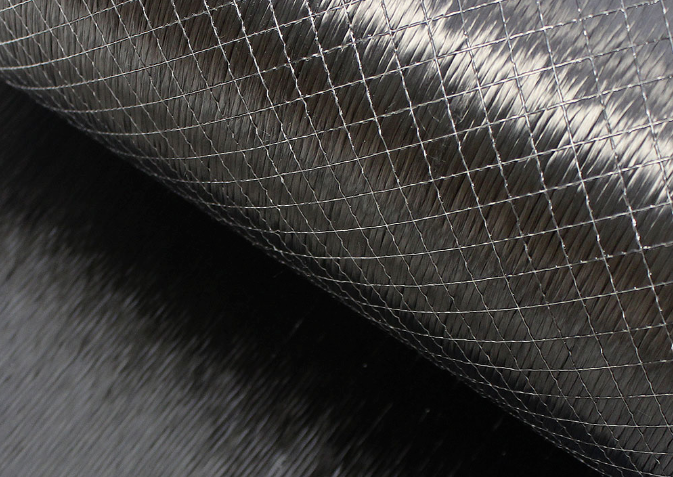
Unidirectional fabrics are also very lightweight, even lighter than comparable woven products. This allows for better control over precision parts and intricate engineering in laminates. Similarly, unidirectional carbon fiber is more economical compared to woven carbon fiber. This is due to its lower total fiber content and fewer weaving processes. This can save on production costs for what would otherwise be seemingly expensive but high-performance parts.
Disadvantages of unidirectional carbon fiber fabric
The greatest advantage of unidirectional carbon fiber reinforced materials is also their greatest disadvantage. They are not suitable for parts requiring significant anisotropic strength properties (strength in all directions). Composite parts used in automotive and other multidimensional applications requiring strength reinforcement in all directions should utilize different weaving patterns, such as plain, twill, or satin weaves.
Another potential drawback is that composite parts made from unidirectional carbon fibers have a very smooth, single-grain surface. If manufacturers want a beautiful, iconic carbon fiber finish, they typically use a single layer of woven fabric as the outermost layer of their layup. For example, bicycle frames are often made from multiple layers of unidirectional fabric placed in different directions for maximum strength and stiffness, and then finished with a 3K twill weave carbon fiber fabric to achieve the "iconic" carbon fiber look.
Applications of unidirectional carbon fiber fabrics
Unidirectional reinforcement is an ideal choice for applications where strength from front to back is paramount. For example, long tubular structures that move primarily in the forward and backward directions (such as rockets, airplanes, and ships) often use unidirectional carbon fiber as a reinforcing material.
Most carbon fiber tubes used in frames (such as those for backpacks and bicycles) utilize unidirectional carbon fiber due to its lightweight and high stiffness. For the recreational and hobbyist market, it can also commonly be found in model airplanes, drones, model boats, model rockets, bicycles, and recreational sticks (hockey, lacrosse, etc.).

Advances in carbon fibers and resins have also led to the wider use of unidirectional carbon fiber reinforced materials in construction and structural engineering. Due to the excellent strength of carbon fibers, they are an ideal replacement for wood or metal in applications such as bridge or building repair. In its various composite forms, carbon fiber reduces construction time, provides greater durability, and minimizes maintenance costs.
The lightweight and stiffness of unidirectional carbon fiber are also utilized in large turbine blades. The increased stiffness and lighter weight allow for longer and thinner blades. The increased length results in a larger swept area, and the thinner, lighter blades are more sensitive to airflow, both of which contribute to greater energy output.
Unidirectional carbon fiber sleeves are also used in sports beyond bicycle frames and handlebars. The combination of excellent fatigue resistance, light weight, and stiffness makes unidirectional carbon fiber ideal for prosthetic blades, such as those used by Paralympic sprinters. Non-directional carbon fiber fabrics are also used in the soles of sprinting and cycling shoes to provide extremely high rigidity and minimal weight in racing situations where energy efficiency is crucial.
Unidirectional superposition
When using unidirectional reinforcement materials, ensure the fabric is smooth, with only the carbon fiber side facing outwards, for the cleanest results. Similarly, spread the resin along the fiber direction—applying it too tightly can cause the non-woven fibers to detach from their binder.
Unidirectional wet layup is the most common method, and vacuum bagging will provide the greatest strength-to-weight ratio. For optimal results, a vacuum infusion process can be used to achieve the ideal resin-to-fabric ratio. Compared to woven fabrics, vacuum infusion will be slightly more difficult due to the slower resin infusion process.